
If you’re trying to figure out which smartwatch is cheaper or easier to fix, here’s the short answer. Apple Watch repairs are generally faster to source parts for and more standardised across models, while Samsung Galaxy Watch repairs can be trickier because parts vary more between generations and the cases are often glued shut rather than clipped. Screens on both are about equally fragile, batteries degrade at a similar rate on both, and bands are the easiest fix on either watch. If you’re weighing up which one will be less of a headache to repair down the track, Apple edges ahead slightly on convenience, but neither is a nightmare if you know a good repairer.
We’ve pulled apart more of these watches than we can count at this point, so here’s what we’ve actually noticed working on both day to day.
Screen Damage: Which One Cracks Worse?
Both watches use a curved or flat glass display bonded to the case, and honestly, both crack in similar ways after a drop or a knock against a doorframe.
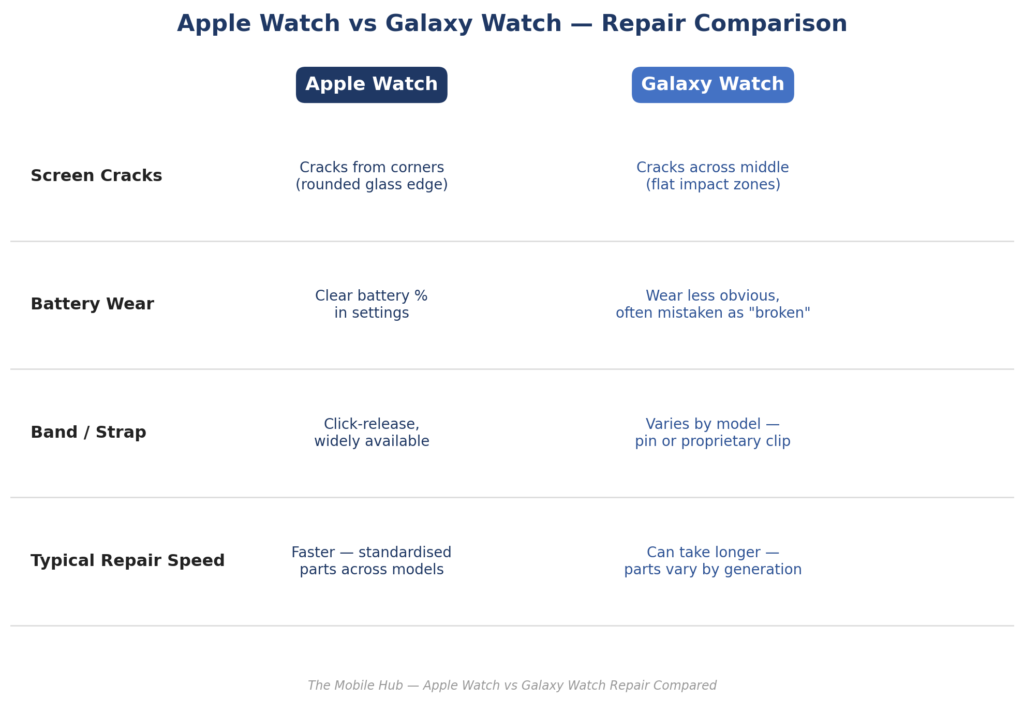
- Apple Watch screens (especially Series 4 onwards) use a more rounded glass edge, which means cracks often start at the corners and spread
- Galaxy Watch screens, particularly the classic rotating bezel models, tend to crack cleanly across the middle if the watch face takes a direct hit
- Both are repairable without replacing the whole unit in most cases, as long as the digitiser underneath hasn’t been damaged too
- Newer Apple Watch Ultra models have sapphire crystal screens, which resist scratching brilliantly but can still crack on a hard impact, and repairs for these take a bit longer due to part availability
In our experience, Galaxy Watch screen repairs take slightly longer simply because we need to source the right generation part, since Samsung doesn’t keep things as consistent across models the way Apple does.
Battery Issues: Which One Holds Up Better?
Every smartwatch battery degrades eventually, that’s just physics, but the way it shows up differs a little between the two.
- Apple Watches tend to show a clear battery health percentage in settings, so you’ll usually know it’s time before the watch starts randomly shutting off
- Galaxy Watches don’t always flag battery wear as clearly, so a lot of customers come to us thinking their watch is broken when it’s actually just a tired battery
- Both watches typically need a battery swap somewhere between 18 months and 3 years of regular daily wear, depending on charging habits
- Fast charging habits (leaving it on the charger overnight, every night) wear out both brands’ batteries faster, so that’s worth knowing regardless of which one you own
If your watch is dying by lunchtime even on a full charge, that’s almost always a battery issue, not a software glitch, no matter which brand you’re wearing.
Band and Strap Problems: The Easy Fix
This is genuinely the simplest repair on either watch, and honestly one we wish more people knew they didn’t need to stress about.
- Apple Watch bands click in and out with a simple button release, no tools needed, and replacements are widely available and often cheaper than you’d expect
- Galaxy Watch bands vary a bit more, some use a quick release pin like a traditional watch strap, others use Samsung’s proprietary clip system depending on the model
- Both watches can suffer from a worn out band connector if you’re rough with swapping straps often, though this is rare
- If your band pin or connector feels loose or won’t clip in properly anymore, it’s usually a five minute fix rather than something to replace the whole watch over
Honestly, band issues are the one repair category where neither brand really has an edge, they’re both easy once you know what you’re doing.
So Which Is Easier to Repair Overall?
If we’re being straight with you, Apple Watch repairs tend to be a touch quicker and more predictable purely because Apple’s ecosystem is more standardised. Samsung Galaxy Watch repairs aren’t harder exactly, they just need a bit more precision sourcing the right parts for your specific model and generation. Either way, both are absolutely worth repairing rather than replacing in almost every case we see.
FAQs
Which is cheaper to repair — Apple Watch vs Galaxy Watch?
Cost varies by model and damage type on both brands. Apple Watch parts tend to be more consistently priced due to standardisation, while Galaxy Watch pricing can vary more depending on the generation. For exact pricing on your model, see our Apple Watch Battery & Screen Repair Cost Guide or get a quote for your Galaxy Watch.
Can a cracked Apple Watch Ultra screen be repaired, or does it need full replacement?
In most cases it can be repaired rather than replaced, though sapphire crystal screens on Ultra models take slightly longer to source and repair than standard Apple Watch glass.
How do I know if it’s my battery or a software issue?
If your watch is losing charge rapidly even from full, or shutting down well before the day is out, that’s almost always a battery issue rather than software — regardless of brand.
Quick recap:
- Both Apple Watch and Samsung Galaxy Watch screens crack in similar ways, though Galaxy repairs can take longer due to part variation across models
- Battery wear is normal on both brands, usually needing a swap between 18 months and 3 years depending on charging habits
- Band and strap fixes are quick and affordable on either watch, and rarely need more than five minutes
- Apple Watches are generally a little faster and more predictable to repair thanks to more standardised parts
- Neither watch is a lost cause when damaged, a proper repair almost always beats buying a replacement
Got a cracked screen, a battery that won’t hold charge, or a band that’s seen better days? Bring your Apple Watch or Samsung Galaxy Watch into The Mobile Hub and we’ll have it sorted quickly and affordably, no need to replace the whole thing.